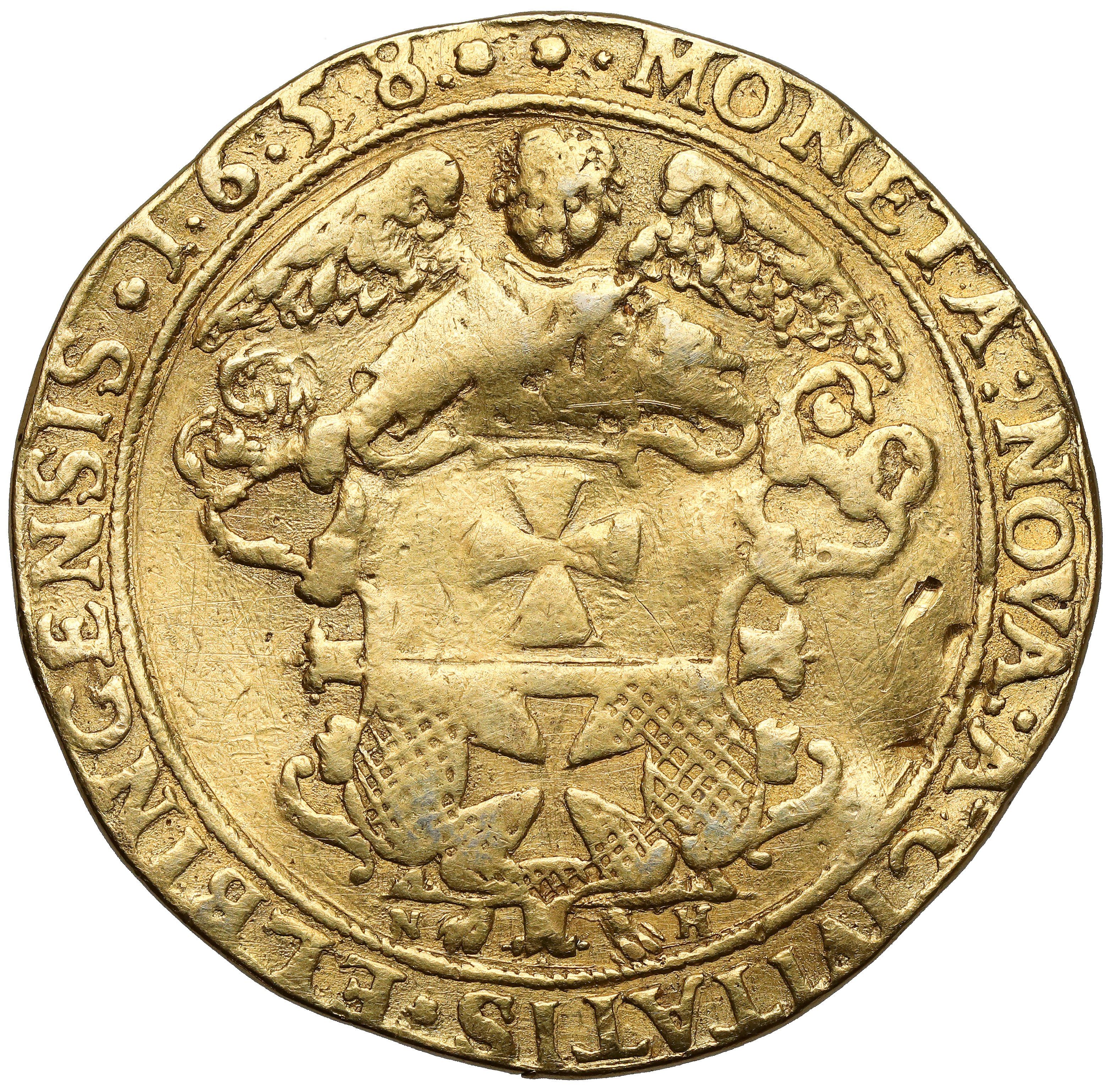
This is the only known piece of the 1658 Elbląg Portuguese coin available on the collectors’ market.
The coin’s provenance dates back to 1920— it comes from the collection of the Barons of Bonde. In subsequent years, it was part of, among others, the outstanding Scandinavian coin collections of Julius Hagender and Ottar Etzeid, which were sold at auctions held by the Künker auction house.
It is only the fourth known piece of this Portuguese coin. The other three are in museum collections:
- the Royal Numismatic Cabinet in Stockholm (the collection of Countess Charlotte von Platen)
- the Numismatic Cabinet in Kraków (the collection of Count Emeryk Hutten-Czapski, now lost during the war)
- the Ateneum Museum in Helsinki (the collection of Herman Frithiof Antell)
Owning an Elbląg gold coin is a great honor that few collectors can afford. Throughout the entire history of its coinage—which, after all, dates back to the times of the Teutonic Order—the city struck gold coins only occasionally, in very small quantities. There are merely a dozen or so issues spanning several hundred years of activity—counting all denominations. That is significantly fewer than the ducats Gdańsk minted during the reign of John II Casimir alone! This is clearly evident in Edmund Kopicki’s*Index*, where these coins are assigned rarity grades of no lower than R8 or R*.
The 1658 “Portugał” is a memento of the Swedish occupation of Elbląg during the Time of the Deluge. As we read in *The Gold of the Vasa Dynasty*:
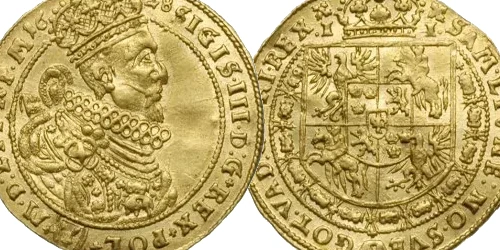
“While withdrawing from the previously captured Elbląg, the Swedes used a thaler die at the city mint in Elbląg to strike gold coins weighing one ‘portugál’ (10 ducats) and half a ‘portugál’ (5 ducats). These coins were used as gifts for Swedish commanders,” and one of the pieces was given to the city’s mayor at the time.
The first Elbląg Portuguese in the history of Polish auctions.
Only the third gold coin from this city to appear in the archives of Polish auction houses. Previously, there were ducats from 1661 and 1658, with their most recent auction prices at 420,000 zlotys and 471,500 zlotys, respectively.
Gold, diameter 41–43 mm, weight 34.52 g
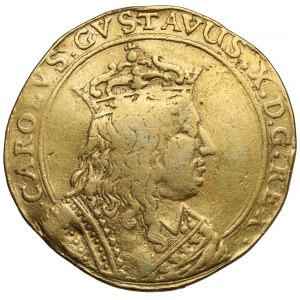
Obverse: a crowned bust in armor and a cloak, facing right. In the rim: CAROLVS GVSTAVUS X D G REX.
Reverse: a standing angel holding a shield bearing the coat of arms of Elbląg on a pedestal, beneath which the initials NH are placed. In the rim: MONETA NOVA A CIVITATIS ELBINGENSIS 1658.