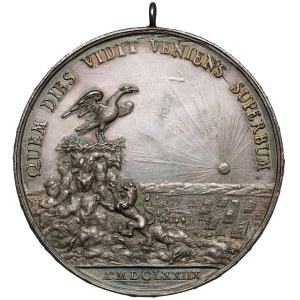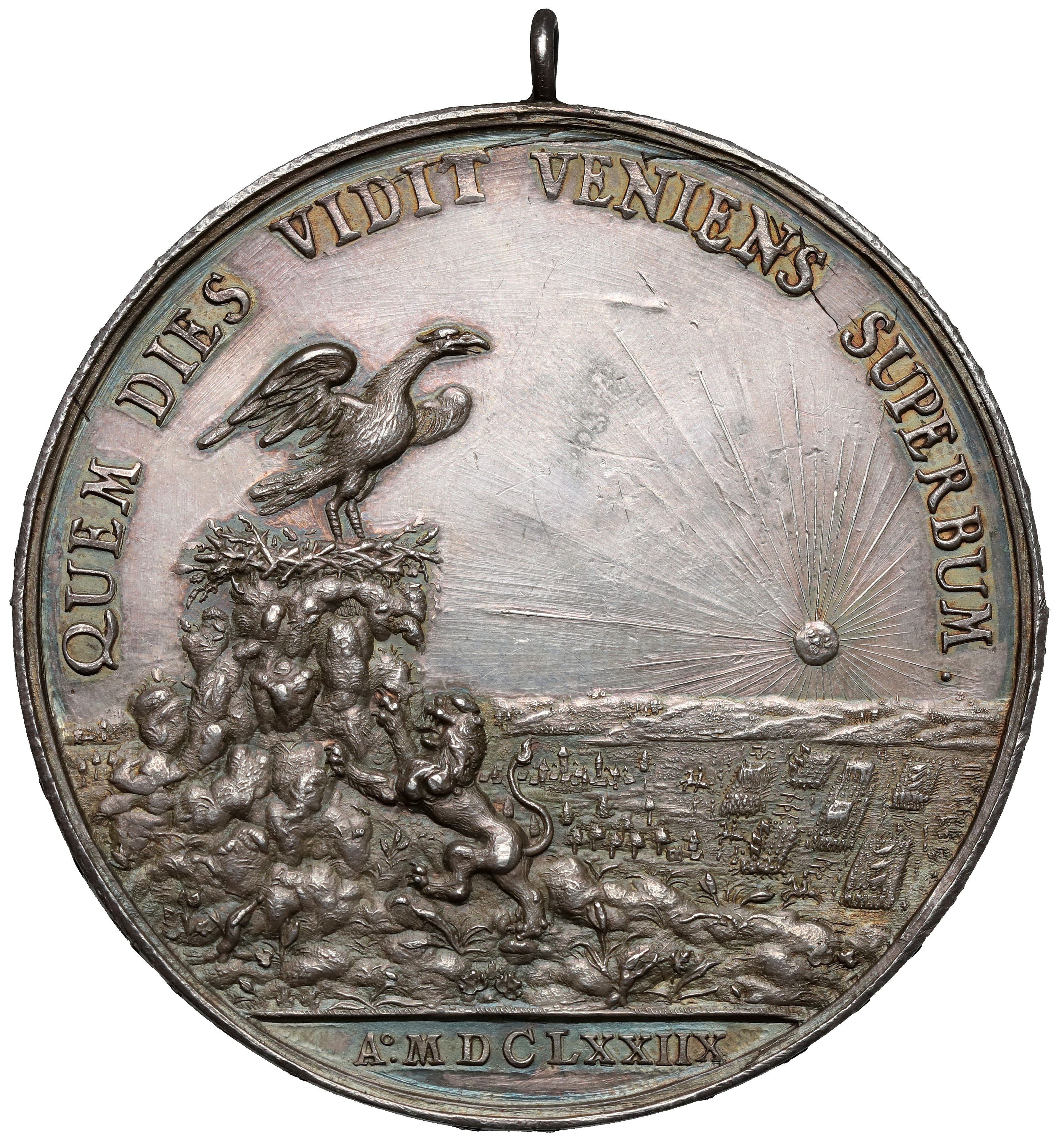
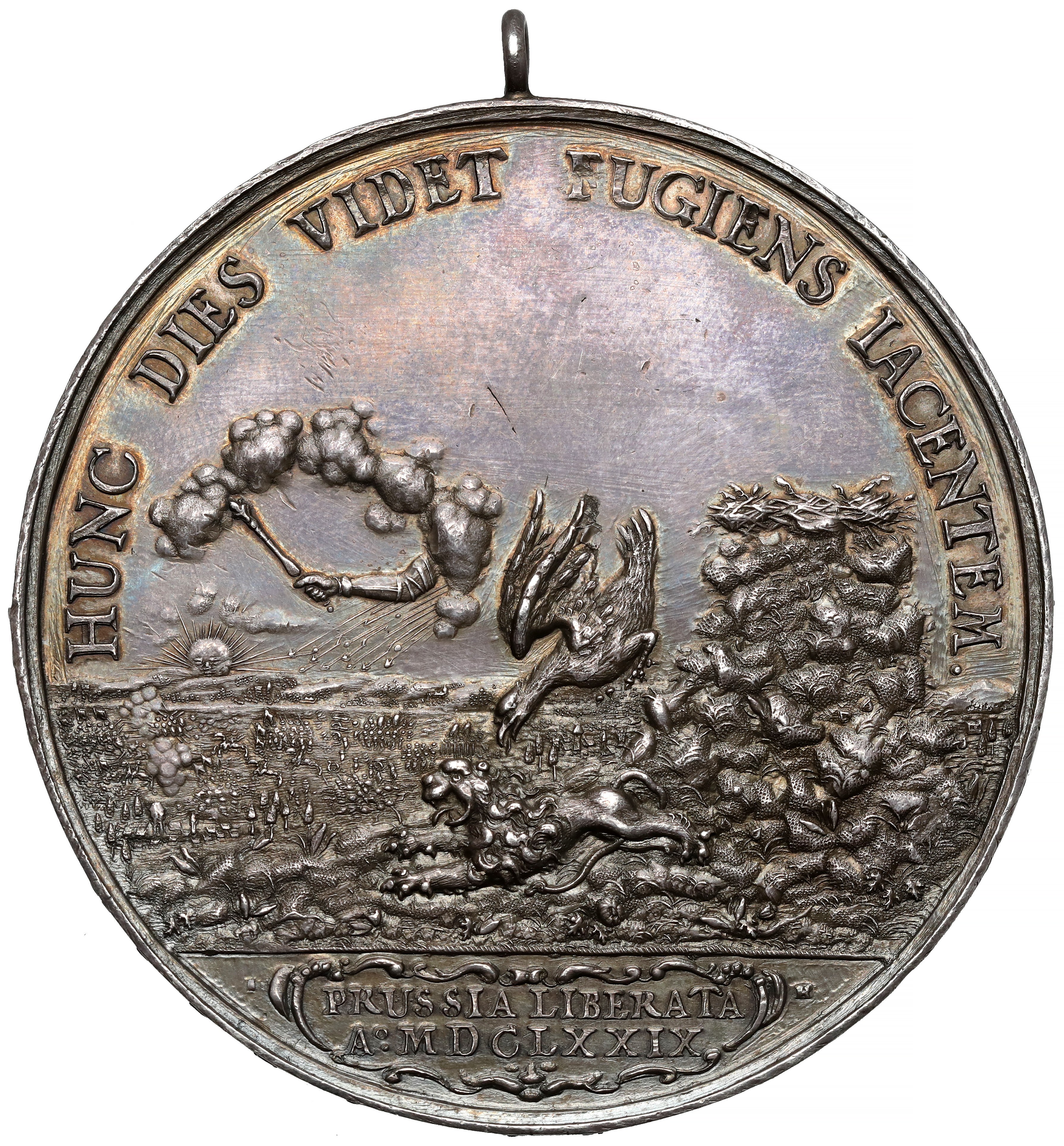

Here is one of the works by the famous Gdańsk medalist— Jan Höhn the Younger—which comes from the collection of Emperor Wilhelm I of the House of Hohenzollern (1797–1888).
The medal was struck for the Prussian Prince Frederick William to commemorate the expulsion of the Swedish army from East Prussia.
It is signed by him with the initials “IH” at the bottom of the reverse, in the section flanking the cartouche bearing the inscription “PRUSSIA LIBERATA Ao. MDCLXXIX.”
An impressive, wide medal (nearly 7 cm in diameter) which, despite the age of the background engraving and the soldered-on loop, retains a fine appearance when viewed in person. The relief is very well preserved, with a cabinet-quality patina.
The obverse depicts an eagle defending its nest against an approaching lion, against a backdrop of an army advancing toward the city gates. The reverse depicts an eagle chasing away the same lion, against a backdrop of a fleeing army, upon which a hand holding a scepter—emerging from the clouds—sends down thunderbolts. Both sides are accompanied by a couplet inspired by Seneca: QUEM DIES VIDIT VENIENS SUPERBUM, HUNC DIES VIDET FUGIENS IACENTEM (whom the coming day saw as proud, the departing day sees as fleeing and defeated)
Ex. Künker 442 / 12.
Silver, diameter 69 mm, weight 84.44 g.