


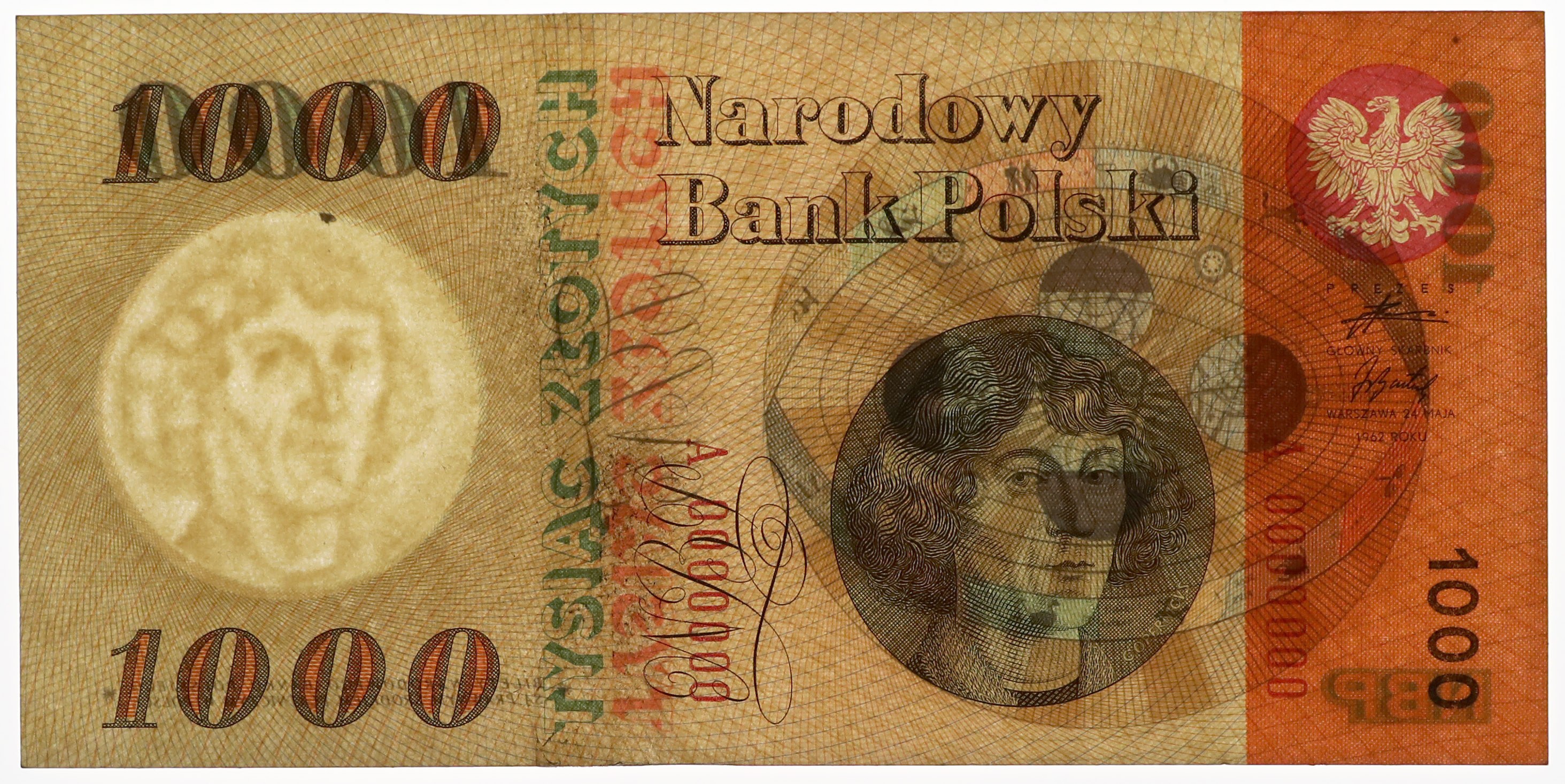
Most likely, it is indeed the only piece of its kind.
The 1,000 zloty Copernicus is a banknote that, although it entered circulation in 1966 (with an issue date of October 29, 1965), had its first issue as early as 1962. It was, however, an issue of trial banknotes only, in the form of zero-numbered designs that are very rare today.
But despite the seemingly already printed final pieces, this was not the end of work on the project.
It is the only known experiment in this form in the history of Polish paper money.
The printed banknote bears a clear green inscription TYSIĄC ZŁOTYCH near the center. However, the ubiquitous color during the communist era, for ideological reasons, was red. And although the 1000 zloty bill with Copernicus is dominated by red, attempts were made to see if it would be possible to smuggle even more of it in here.
Attempts were made to replace the green notation of the denomination with red.
The attempts were realized by sealing the green writing with a strip of red writing. The red writing was taken from a clipping from the reverse side of these banknotes. However, for better legibility, a print of the reverse without the main layer and without the NBP monogram was used (they probably had such readily available at the time from recycled paper, or they could order an unfinished print from PWPW).
Manufactured proofs with a glued-on red stripe are among the highest rarities of the period. We only had one such on offer once (in auction 4 in 2018!). On the other hand, the pieces offered in this auction show traces of the sticking of the stripe and its subsequent removal. Whether the removal was done back then, in the era, as part of the tests carried out, or in a later period considering it "collectively redundant", for example, it is impossible to determine at present. What is certain, however, is that we are dealing here with a very rare piece, on which experiments were carried out, when work was carried out on the final version of the new 1000 zloty banknote.







