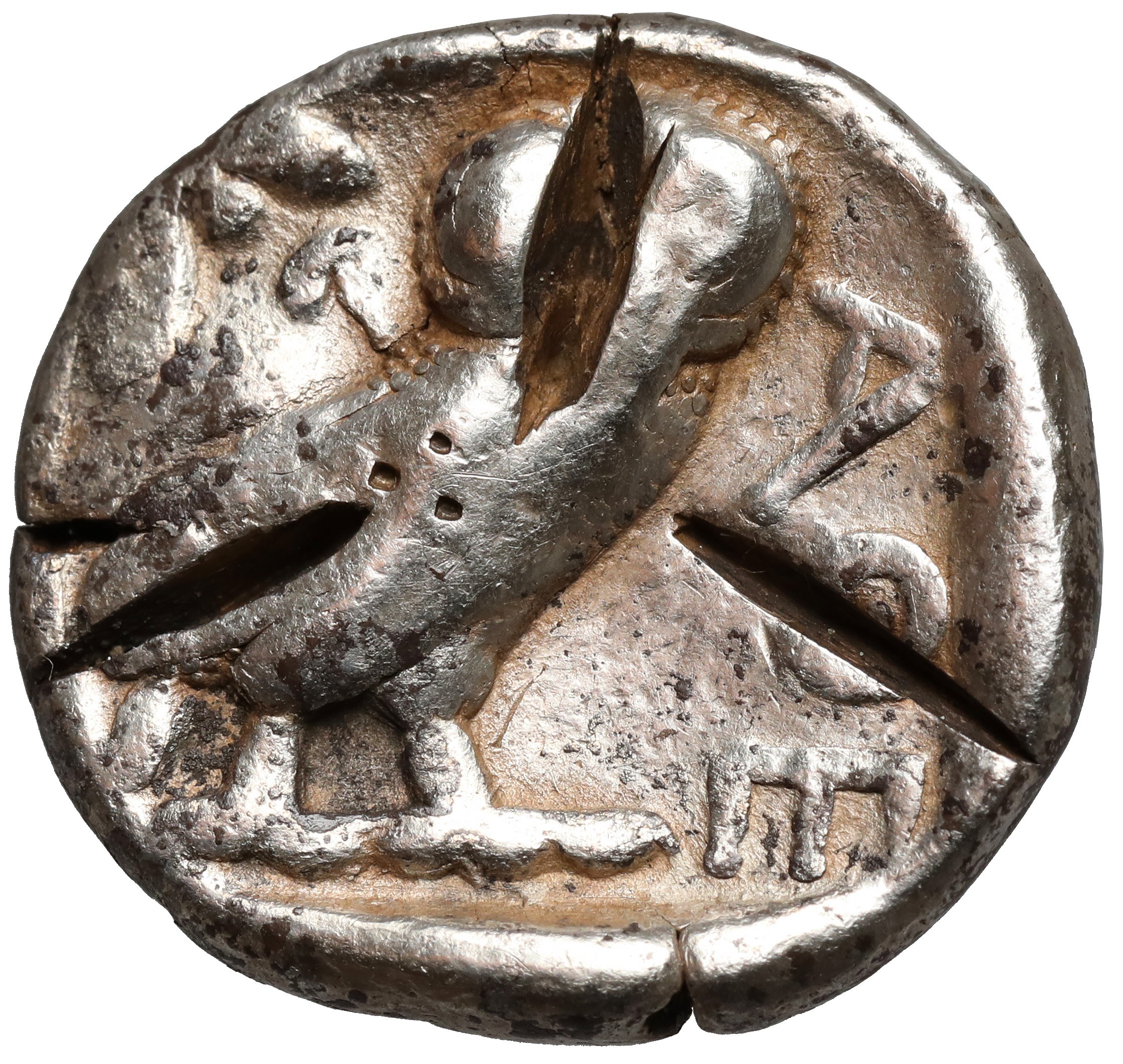
The famous “owl” coin—so named because of the distinctive design on its reverse—is a coin that, as Mariusz Mielczarek emphasizes, became one of the most important means of payment throughout the Greek world of the Classical period in the 5th century B.C. The coin was minted at the height of Athens’ economic and political power or at the beginning of this mighty polis’s decline following its defeat in the Peloponnesian War (431–404 B.C.). We can safely say that the Athenian tetradrachm was the equivalent of today’s dollar in terms of trust, which is why the Athenians did not change the coin’s design for nearly a century.
Obverse: The head of Athena, facing forward with her eye depicted “head-on”
Reverse: An owl facing forward, with an olive branch and a crescent moon behind it, and the inscription AΘE.
Silver, diameter 25 mm, weight 16.96 g.
Test engraving on the obverse and reverse of the coin.